Start With the Chains, Not Against Them
The chains are the reason Chained Beasts becomes difficult—and the tool that can make a losing arena fight manageable. Treating them as a nuisance leads to tangled teammates, missed attacks, and avoidable damage. Learning to control their position lets you knock enemies down, create openings, and turn a restrictive mechanic into your strongest form of crowd control.
Chained Beasts is a one-to-four-player gladiator roguelike where animal fighters battle through brutal arenas for freedom, revenge, or both. Runs combine close-range combat, throwable objects, weapon management, crowd favor, permanent injuries, randomized perks, equipment, and escalating bosses.
Do not sprint in separate directions at the start of a wave. Instead, identify the arena hazard, decide where the group should hold ground, and move as a unit. A short chain is much easier to exploit than a chain stretched across the entire arena.
| Early priority | Why it matters | Practical habit |
|---|---|---|
| Learn chain spacing | Prevents teammates from being pulled into danger | Stay within one shared combat zone |
| Find throwable objects | Gives ranged damage and setup options | Save pots, urns, and loose weapons for priority targets |
| Watch stamina | Avoids being helpless after repeated attacks | Pause after a combo and block or reposition |
| Build crowd favor | Can provide meaningful run support | Use varied kills, executions, hazards, and weapons |
| Protect weapon access | Losing a weapon can change a fight quickly | Know where a replacement is before throwing yours |
Solo runs can place a heavy ball or other anchor at the end of your restraint instead of a partner. The same principle applies: do not fight the pull blindly. Circle around the anchor when possible, use its position to limit enemy approaches, and pull the chain across targets rather than simply away from it.
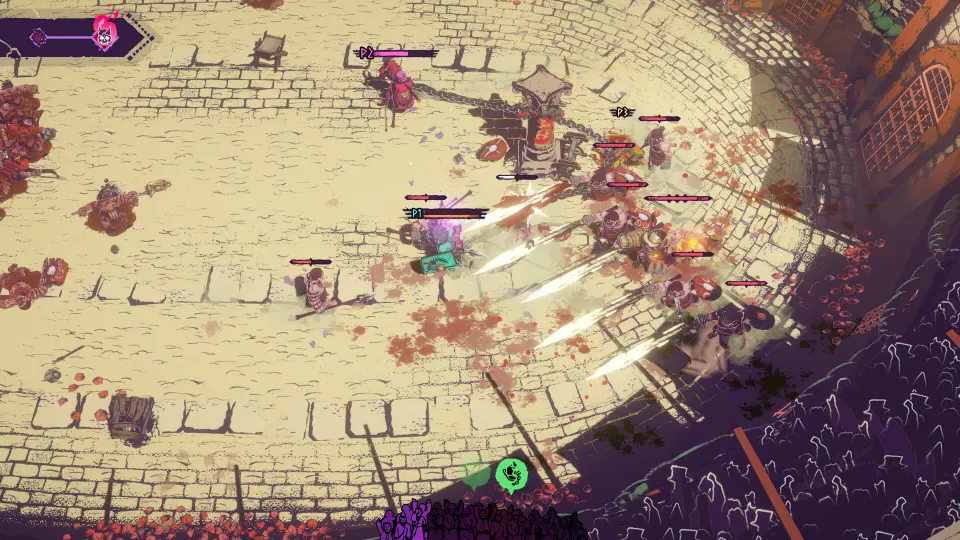
Win Fights With Positioning and Chain Trips
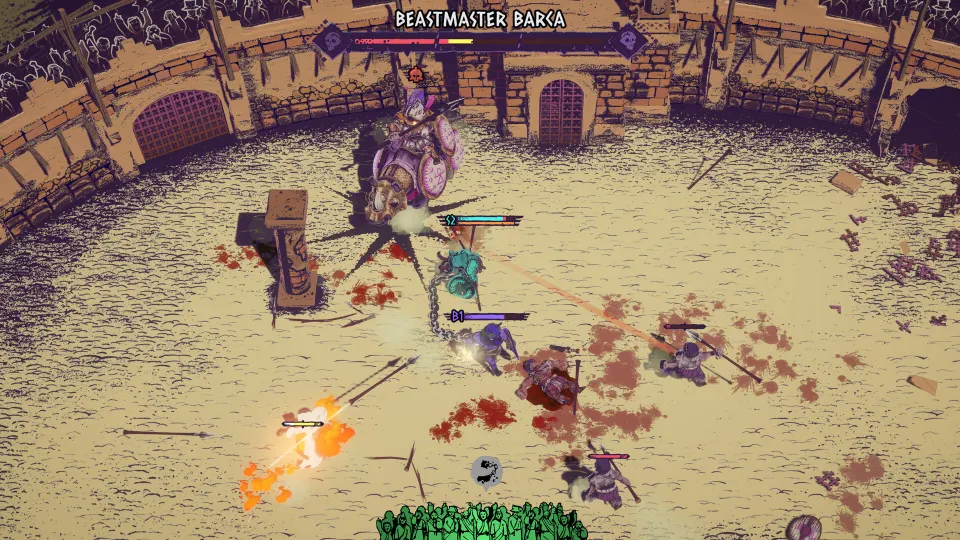
A chain can trip enemies when it crosses their movement path. This is the central technique to practice. A fallen enemy cannot pressure the team for a moment, and that opening is ideal for a strong melee hit, an execution, a thrown weapon, or a shove into an arena hazard.
Set up trips by letting an enemy commit toward one fighter while another moves across its path. Avoid frantic movement. The useful motion is deliberate: create a line, lure the enemy through it, then capitalize immediately.
| Situation | Best response | Common mistake |
|---|---|---|
| Enemy advances in a straight line | Cross its path with the chain | Running directly away until the chain is taut |
| Team surrounds a pillar | Move together around one side | Splitting directions and becoming tangled |
| Heavy enemy closes in | Trip, block, then punish while it is down | Trading repeated melee hits |
| Target stands near spikes or a pit | Push, throw, or drag it toward the hazard | Fighting in open ground without using the arena |
| Several enemies cluster | Use a throwable before entering melee | Spending stamina on every enemy individually |
Blocking matters more as difficulty rises. A well-timed block can stun an attacker and create a safer counterattack window. Shields are valuable, but they can break, so do not make your entire plan depend on holding one forever.
Keep these combat rules in mind:
- Use basic attacks for controlled damage and charged attacks when an enemy is committed or downed.
- Throw weapons when distance, enemy positioning, or an objective makes the risk worthwhile.
- Pick up and throw arena objects to interrupt dangerous enemies or finish weakened targets.
- Let enemies hit one another when they bunch up.
- Do not chase every enemy separately in co-op; choose a shared target area.
- Save a clear route to a spare weapon if your current tool breaks or gets thrown.
Weapons favor different styles. A bow helps from a safer distance but has limited ammunition. A flail can deliver enormous damage but slows movement and demands careful aim. Swords, axes, spears, maces, and shields offer different balances of reach, speed, defense, and throwing value. Try to match your weapon to the arena instead of forcing every fight into the same pattern.
Manage Injuries, Perks, and the Crowd
Survival between battles is often harder than the battle itself. Damage may force you to choose a potion or other recovery option with an unwanted side effect. Afflictions can include impaired vision, hallucinations, limps, disarms, or other problems that change how safely you can play. A full heal is not always the best choice if the downside destroys your plan.
If an affliction creates fake enemies or visual confusion, slow down and confirm targets before committing resources. If it limits mobility, avoid wide open chases and keep fights near predictable lanes. When an injury makes blocking, aiming, or weapon handling less reliable, shift your role toward support and environmental damage.
| Run system | What it offers | How to use it well |
|---|---|---|
| Potions and recovery | Healing with possible harmful effects | Choose the drawback your build can tolerate |
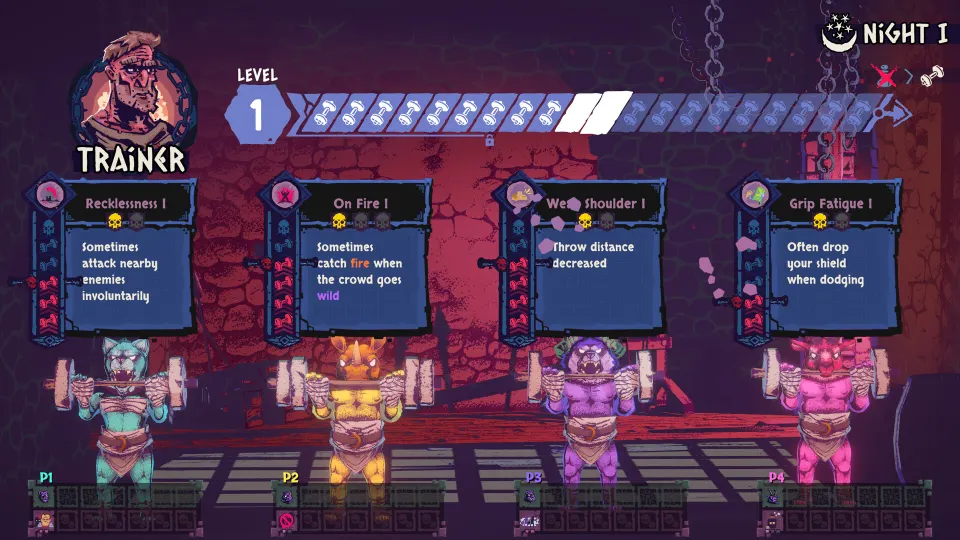
| Training or leveling | Perks and stat improvements | Stop before overextending into a penalty when possible |
| Crowd favor | Rewards for exciting arena performance | Mix executions, hazards, weapon kills, and takedowns |
| Challenges or jobs | Extra money for precise objectives | Accept only when the goal fits your current weapons |
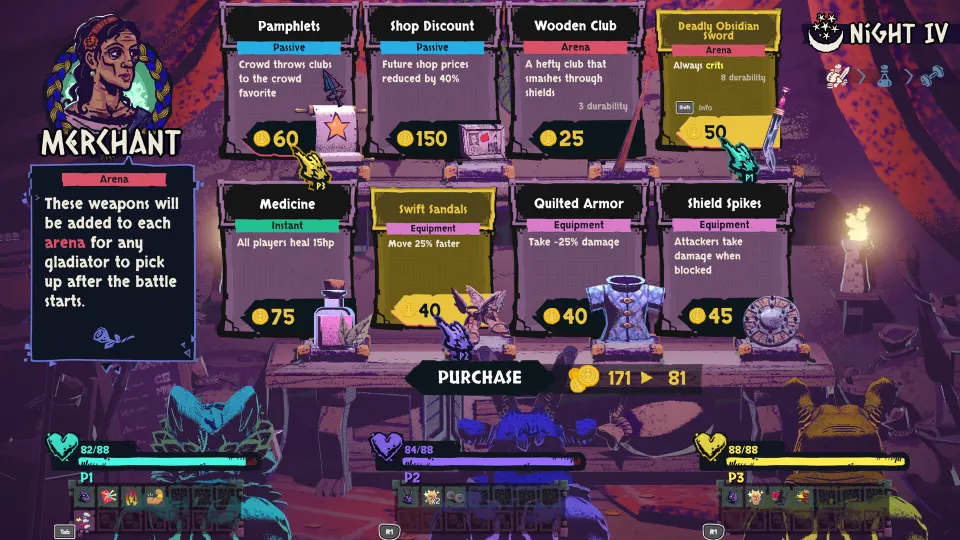
| Shops | Weapons, armor, and equipment | Buy for the next dangerous fight, not just the current one |
| Character unlocks | New abilities and play styles | Pick a fighter that supports your team’s role distribution |
Crowd favor rewards creativity. Repeating the same safe attack may clear a wave, but varied kills can make the crowd more enthusiastic. Executions, environmental kills, weapon throws, and dramatic takedowns are useful not only because they look good, but because they can improve the run’s momentum.
Challenges deserve special caution. A contract that asks for a specific number of thrown kills can pay well, but it can also force risky behavior. First weaken enemies without killing them, then reserve a throwable for the final blow. Once the objective is complete, stop taking unnecessary risks to preserve the requirement.
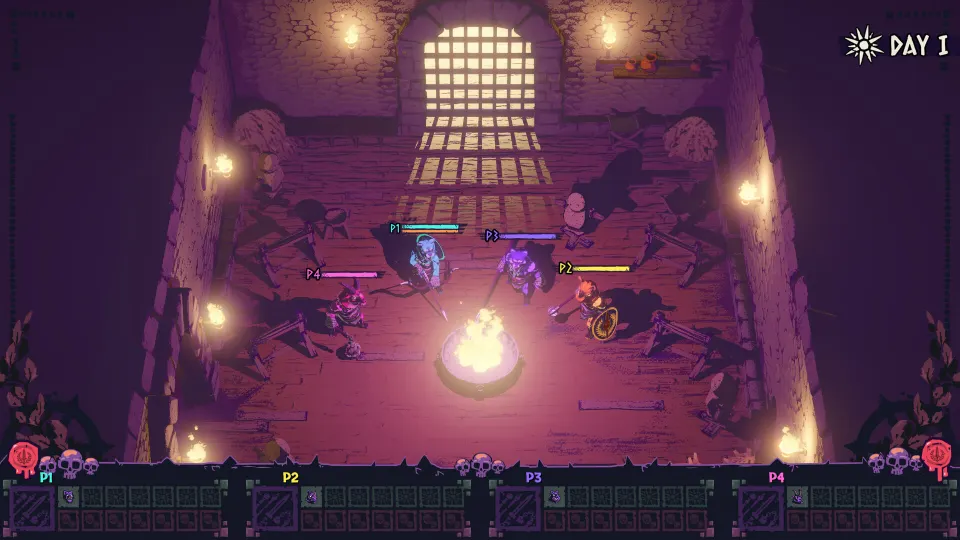
Build a Co-op Team That Does Not Tangle
Co-op is where Chained Beasts becomes most distinctive. Four players chained together can overwhelm an arena, but only if everyone recognizes that movement is shared responsibility. A powerful individual build will still fail if the group repeatedly stretches the chain across hazards or pulls a low-health ally into a crowd.
Assign loose roles rather than rigid jobs. The point is not to force one player into a class; it is to make moment-to-moment decisions faster.
| Team role | Main focus | Useful equipment or behavior |
|---|---|---|
| Frontliner | Holds enemy attention and blocks | Shield, sturdy melee weapon, deliberate spacing |
| Trip setter | Creates chain knockdowns | Moves across enemy paths and calls targets |
| Finisher | Converts openings into kills | High-damage melee, executions, charged attacks |
| Thrower | Controls space from range | Bows, thrown weapons, urns, and hazard setup |
| Support player | Watches health, items, and recovery choices | Stays aware of allies and avoids chain tension |
Call out simple directions: “left,” “hold,” “trip,” “back,” and “weapon.” Long explanations during a wave usually arrive too late. Before entering a new fight, agree on one side of the arena to claim and one hazard to exploit.
When an ally falls, avoid panicked rescue attempts that pull the entire group through enemies. Clear a small safe lane first. If someone is carrying a downed teammate or trying to revive, the other players should focus on interruption and space control rather than pursuing distant enemies.
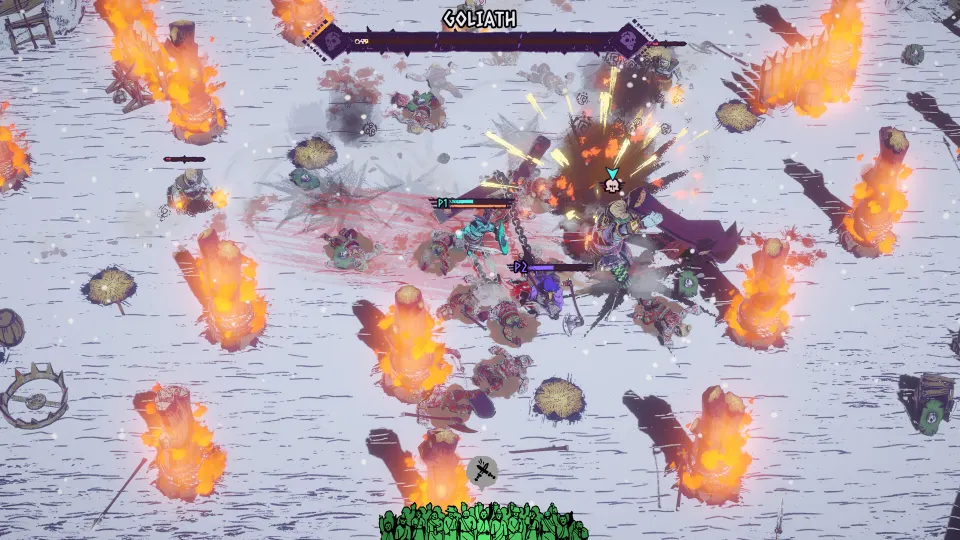
Bosses demand even more discipline. They are arena heroes with significant advantages, and survival can matter more than immediate damage. Keep the chain from locking everyone into the same attack, maintain access to weapons, and use the arena whenever the boss gives you room.
FAQ
What is the best first lesson in this chained beasts guide?
Learn to trip enemies with the chain. Move across an enemy’s path, knock it down, and immediately use the opening for a heavy attack, execution, or hazard setup. This changes chains from a restriction into a dependable weapon.
Can Chained Beasts be played alone?
Yes. Solo play uses a chained restraint or anchor rather than a full team connection. You still need to manage chain physics, but you can use the anchor’s position to control enemy paths and create trip opportunities.
How many players support co-op?
Chained Beasts supports one to four players. Co-op can be played with friends, and the game is designed around the chaos and coordination of linked gladiators.
Should I always take healing after a battle?
No. Recovery choices can bring afflictions that may be worse than low health for your current build. Consider the next arena, your weapons, and whether the drawback harms your most important tactic before choosing.
How do I make the crowd happier?
Use varied, dramatic methods: executions, weapon throws, environmental kills, knockdowns, and different weapons. The crowd responds better when fights are not solved with the same attack every time.