Why Local Co-op Is the Best Kind of Chaos
Chained Beasts local coop matters because the chain between gladiators is not just a visual gimmick: it changes every movement decision, rescue, and attack. A well-coordinated group can turn that restriction into crowd-pleasing traps and enemy knockdowns. A disorganized group may instead wrap itself around pillars, drag allies into danger, and create the sort of disaster everyone remembers.
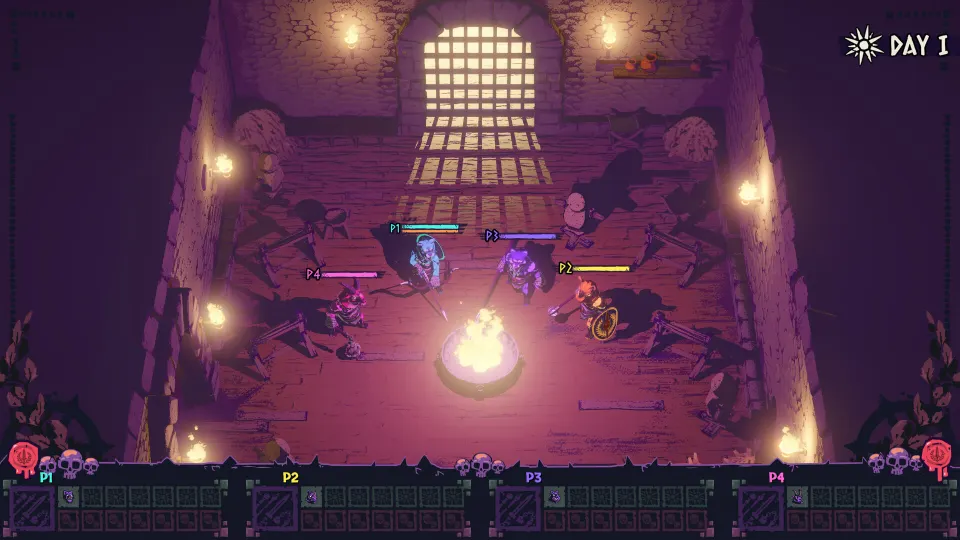
Chained Beasts is a top-down gladiator roguelike for one to four players. It supports shared or split-screen co-op alongside online play, so a local group can enter the arena together on one system. The game is designed around chaotic cooperation, environmental combat, permanent run pressure, and injuries that can alter how a gladiator performs.
| Local co-op feature | What it means for players |
|---|---|
| Player count | Up to four players can fight together |
| Screen support | Shared and split-screen co-op are supported |
| Core constraint | Teammates are physically linked by chains |
| Required hardware | At least one gamepad is required for same-screen co-op |
| Supported PC systems | Windows and macOS |
The local mode is especially suited to players who enjoy talking through a plan while everything immediately falls apart. Everyone can see the same arena threats, but each person still has to manage their own position, weapon, health, and upgrades. That makes communication useful without making the game feel slow or overly technical.
Setting Up a Local Arena Team
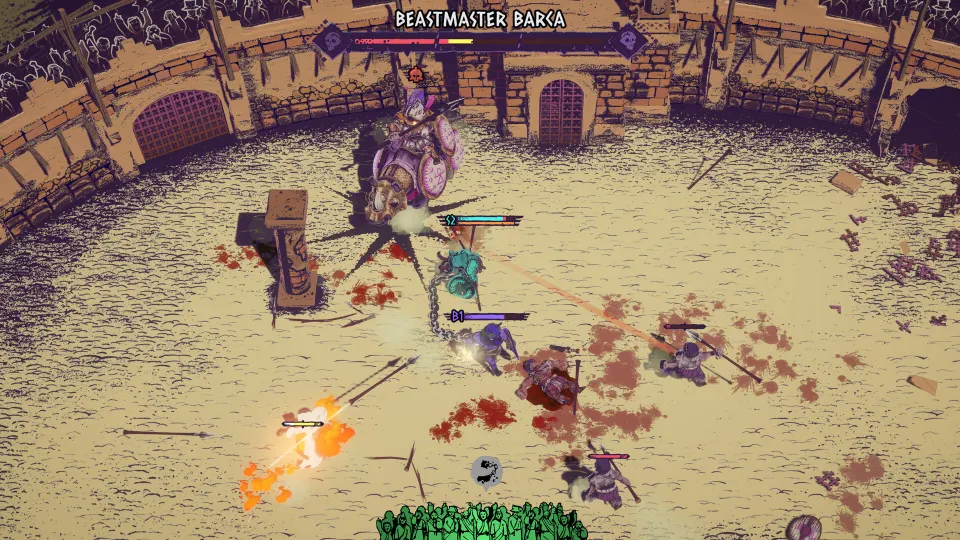
Before a Chained Beasts local coop session, make sure at least one gamepad is connected. The official system requirements specifically note this requirement for same-screen co-op. Since several players can be tethered together, having the group settle on basic movement habits before a difficult run will save plenty of avoidable damage.
Start with a simple goal: stay generally in the same area rather than pursuing separate enemies at opposite edges of the arena. The chain has enough tactical value that it should be treated as shared equipment, not as a penalty one person must constantly fight.
A new group should follow this approach:
- Begin with two players if the team is learning the chain mechanic.
- Pick a direction before crossing the arena or circling a pillar.
- Let one player call out major repositioning moves.
- Avoid chasing weakened enemies alone when the chain is stretched.
- Use open space to reset the group after a messy fight.
- Add more players once everyone is comfortable watching the chain and nearby hazards.
| Team size | Local co-op feel | Main challenge |
|---|---|---|
| 1 player | More deliberate and strategic | No teammate chain coordination |
| 2 players | Easier communication and positioning | Learning when to pull or yield |
| 3 players | More combat options and more confusion | Keeping the chain clear around terrain |
| 4 players | Maximum spectacle and chaos | Avoiding tangles, friendly disruption, and split focus |
Four-player runs can be extremely funny, but they demand more awareness. Each added gladiator creates another source of pressure on the chain and another player who may be aiming at a different target. The most successful groups do not try to eliminate all chaos; they learn when to use it.
Using the Chain and Arena to Win Fights
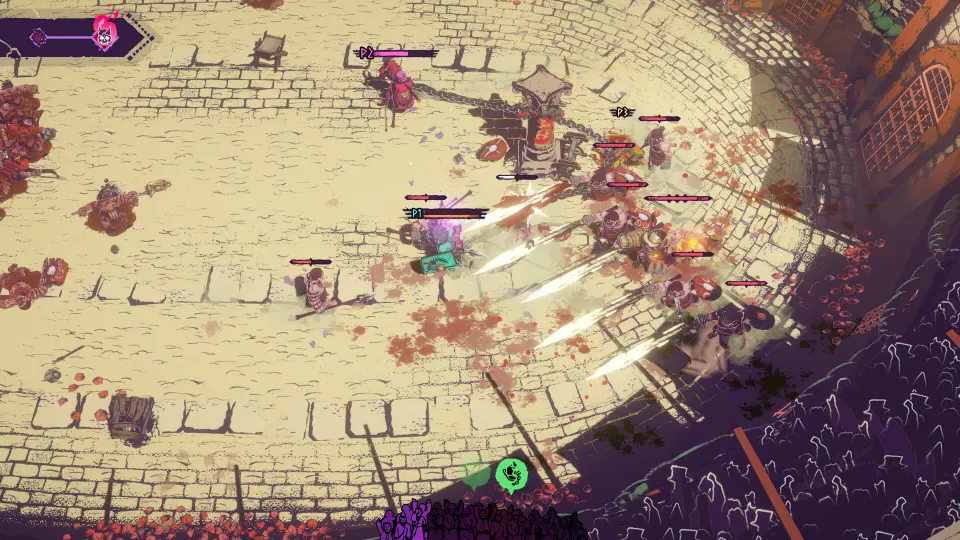
The chain is the defining tool in local play. When teammates synchronize their movement, they can trip foes, control space, and create openings that would not exist in a normal action roguelike. When teammates move without considering one another, the chain can pull fighters out of range, block escape routes, or leave the group trapped around arena scenery.
Think of the team as a moving formation. One player can draw enemies toward an open section of the arena while another swings around the side. If the group moves together at the right moment, enemies can be caught in the chain’s path or forced into dangerous terrain.
| Arena option | Useful local co-op play |
|---|---|
| Pillars | Circle carefully to control enemy paths, but do not knot the chain around them |
| Spike walls | Push or charge enemies into them when the team has room to retreat |
| Snake pits | Force enemies toward them instead of entering the hazard as a group |
| Urns and loose objects | Throw them to interrupt or damage foes |
| Weapons | Use melee weapons up close or throw them at distant threats |
| Open floor | Regroup here when the chain becomes tangled or the team is surrounded |
Environmental interaction is a major part of combat. You can throw enemies into objects, hurl urns at opponents, send foes into traps, and toss weapons for ranged pressure. These options are especially valuable in local co-op because a teammate can create an opening while another player delivers the finishing hit.
Do not overlook the crowd. Fighting with flair and using the arena creatively helps win over the spectators, who are part of the game’s progression and combat presentation. A safe but unimaginative approach may keep the team alive, while an aggressive environmental play can create stronger momentum and more memorable outcomes.
The best chain tactics are usually simple:
- Move in an arc instead of directly through teammates.
- Pull enemies toward hazards only when the full group has an exit route.
- Call out when circling a pillar or changing sides.
- Keep one player near a fallen or pressured ally rather than scattering.
- Use the chain to disrupt enemies, then quickly regroup before pursuing another target.
Surviving Runs, Injuries, and Bosses
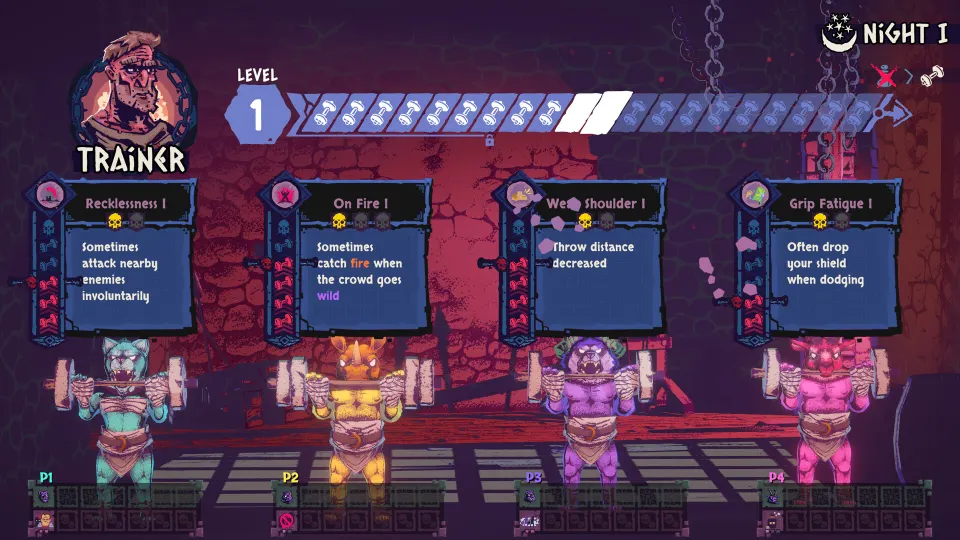
Local co-op does not remove the roguelike challenge. Every arena day can leave gladiators with physical or mental injuries, and those afflictions may meaningfully change the run. A limp, damaged vision, hallucinations, or other setbacks can make a capable player suddenly need more help from the group.
Potions can relieve pain, but they may introduce unwanted side effects. That tradeoff is central to the game’s run-to-run decisions: healing is not always a clean reset, and surviving now may create a harder problem later. Local teams should discuss these choices, especially when one player’s condition could affect everyone tethered to them.
| Run element | Why it affects local co-op |
|---|---|
| Injuries | A weakened player can change the whole team’s positioning needs |
| Potions | Healing may come with side effects that alter future encounters |
| Skills | Different abilities let players specialize in control, damage, or survival |
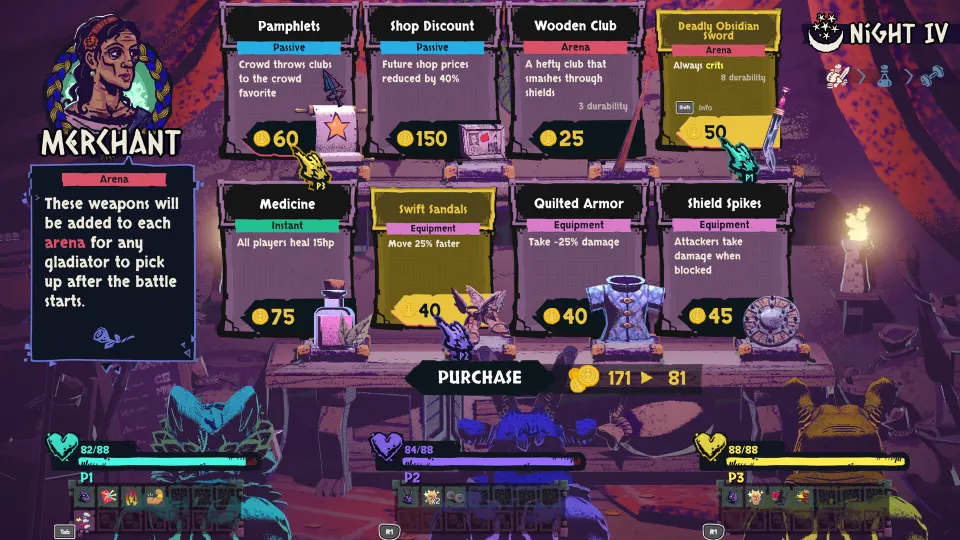
| Equipment | Purchased weapons and items can reshape the team’s options |
| Crowd favor | Strong performances can support progression |
| Bosses | Powerful arena champions test chain coordination under pressure |
Between battles, use the quieter moments to compare what the group needs. A fast weapon user may benefit from support that creates openings. A player relying on thrown weapons may need teammates to hold enemies in place. Someone carrying injuries may need the group to avoid tight terrain and rapid direction changes.
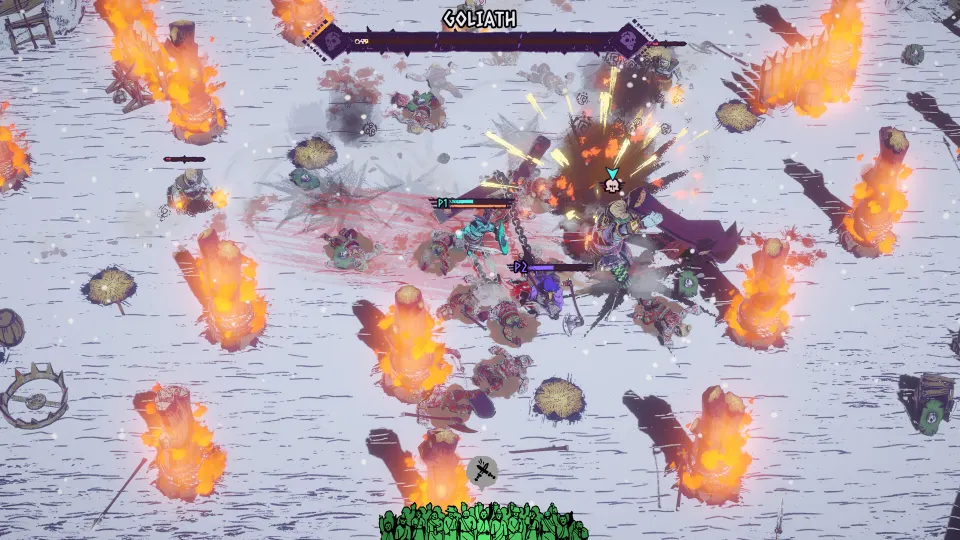
Boss fights raise the stakes further. These opponents are presented as heavily armed arena champions with major advantages, so the team should prioritize survival over flashy plays when the arena becomes crowded. Keep enough space to dodge, avoid wrapping the chain around obstacles, and do not let every player attack from the same angle.
Progression gives a run more than one answer to a difficult fight. Players can learn skills, earn crowd support, save money, buy gear, and unlock characters with distinct abilities. That variety means local groups can experiment with different roles rather than repeating the same strategy every session.
FAQ
Does Chained Beasts local coop support four players?
Yes. Chained Beasts supports one to four players in co-op, including four-player local play through shared or split-screen support.
Do I need a controller for local co-op?
At least one gamepad is required for same-screen co-op according to the game’s system requirements. Connecting controllers before starting a session is the safest way to avoid setup issues.
Can local players use the chain against enemies?
Yes. The chain is designed as a combat and movement tool. Coordinated players can use it to trip enemies, control positioning, and create opportunities around arena hazards.
Is Chained Beasts playable alone?
Yes. It includes single-player play, though the game is built primarily around co-op action. Solo play is generally more deliberate, while a full local group is faster, louder, and less predictable.
Is local co-op the same as online co-op?
They are separate ways to play together. Local co-op uses shared or split-screen play on one system, while online co-op connects players remotely. Both center on the same chained gladiator combat.